MY ODYSSEY INTO AM SYSTEMS
Kill your notifications, put on some lo-fi, and listen closely. I’m about to tell you the history of Acousto-Magnetic systems exactly as it is—unfiltered and uncensored. It’s high time I laid this out; people have been asking for a while. Tune into the frequency while I explain the roots of AM systems, why they use specific frequencies, why jammers aren't a "magic wand," and the specific electrical hell of Moscow. I’ll also cover how this tech evolved, how it operates now, and the future of AM in the world of Loss Prevention.
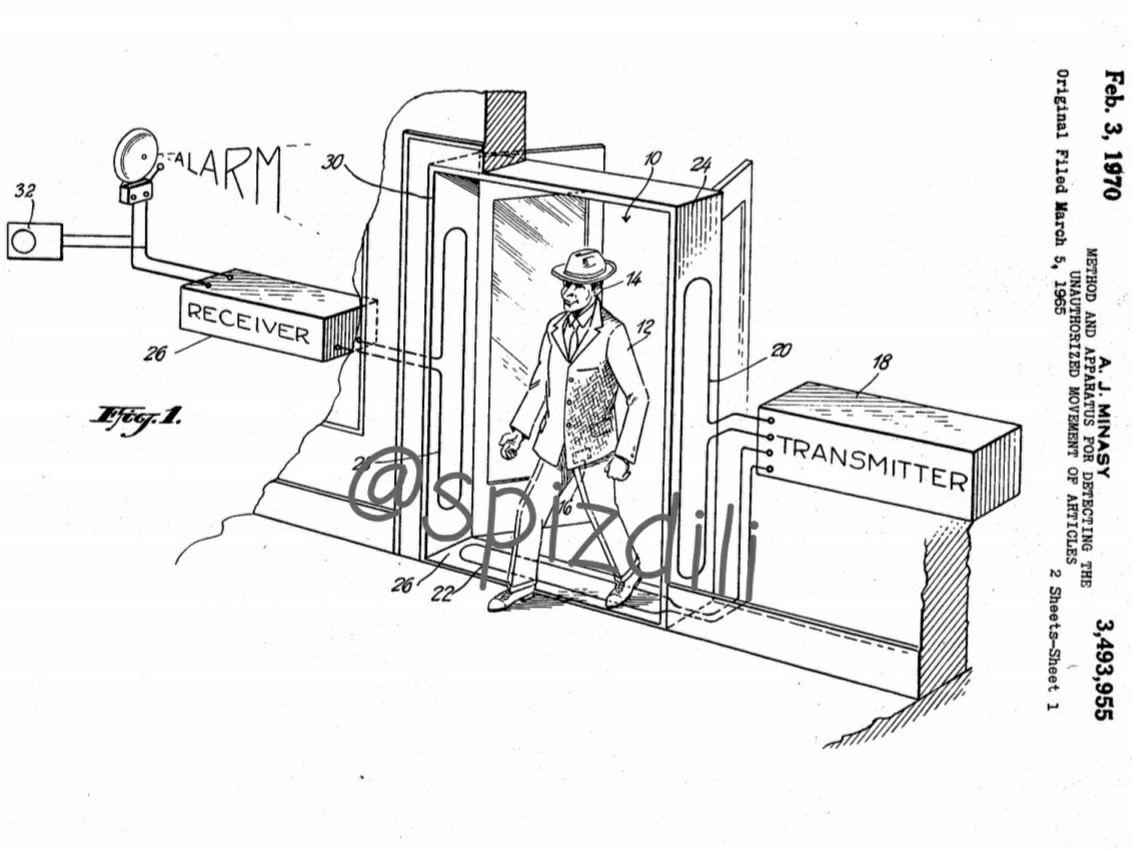
Technology Roots: The 1965 Patent and Magnetostriction
The oldest patent I’ve managed to dig up dates back to 1965, belonging to Sensormatic Electronics Corporation. Who knows, maybe someone was tinkering with it even earlier (Patent US3292168A "MAGNETOSTRICTIVE MARKER AND DETECTOR"). Think about that: this technology is over 50 years old. They started pushing it into retail over half a century ago. It doesn't matter much why they did it back then; what matters is that it started as a simple 58 kHz signal—those classic magnetostrictive strips.
The whole concept runs on magnetostriction. Google it if you want the deep dive. In short: it’s a dance of metal strips that create a specific electromagnetic—effectively magnetic—response when touched by the field. Why "Acousto-magnetic"? "Acousto" refers to something near-sound. And it actually makes sound! If you hold a jammer right up to a tag, you can hear it rustling. That rustle at 58 kHz, with its specific periods, can be caught by the human ear. But here’s the catch: 58 kHz is just the carrier frequency. The signal is a mess of different frequencies, periods, interruptions, and other technical jargon. There are a million variations. It’s "Magnetic" because it’s the reaction of magnetic strips made of special materials with residual magnetization.
By the way, I’m dictating this in one take—no retakes, no scripts (transcribed from a voice recording, maybe I'll upload the podcast later). If I repeat myself, deal with it. I’m in a flow state today. It’s been a hell of a day, but this info is hard-coded in my brain. Let’s keep moving.
How AM Systems Operate
The strips work on magnetic reactions. They designed gates (pedestals) that create this field and analyze the tag's response. How? Suppose the gate "works" on the tag for a specific time—say, one millisecond. After that, the tag continues to "rustle" for a bit due to inertia, so to speak. This is the residual magnetization of the strips. The gate magnetizes the strip, shuts off, and the strip keeps vibrating for a short window. In that precise moment, the gate switches to "listen" mode. It cuts out and listens. 58 kilohertz means 58,000 oscillations per second—that’s the gate’s frequency.
What’s next? The gate shuts off, listens—if there’s a tag, bingo. If the tag is present, it shows up on the receiver antenna... Originally, there were two pedestals: one to transmit, one to listen. Modern tech has evolved—now both antennas transmit and both listen. High-end filters and digital processing allow this; modern RF checkpoints are basically computers with a web-based OS for tuning.
Evolution and the War on Interference
Back in the 60s, there weren't many sources of magnetic interference at these frequencies. Very few transformers, very little "noise." But the world didn't stop. Electronic devices appeared; stores filled up with equipment, specialized lighting, signs, and refrigerators. Reinforced concrete buildings became the norm, and sometimes "geniuses" would run phase or ground wires through the metal structural frames, causing shorts. By the mid-2000s, all AM manufacturers had to sprint forward. Why? Because the gates started glitching like crazy. They became impossible to tune. These manufacturers weren't "protecting" themselves from us—they didn't give a damn about the tech itself.
The world just became too noisy. Ordinary life was creating too much interference. A tiny cart driving through a mall with its own light show and electric motors creates enough noise to drown out the pedestals. Even the modern Synergy systems... I remember one mall where a kids' train drives right past the latest Sensormatic Synergy gates. Every time it passes, the gates scream because they can't figure out what that mess of interference is. Tuning them out is a nightmare because of the LEDs, motors, and other crap. That’s the modern world. AM technology has had to get more complex since the 60s just to survive in this electronic chaos. The gates got smarter, but they weren't hardening against shoplifters.
Gates didn't get tougher because of shoplifters, and they aren't getting tougher because of them now. Not because of you, not because of me, and not because of my jammers. They do it just so the hardware can survive in this digital shitshow. Take the "Europolis" mall (formerly Golden Babylon)—it’s an absolute disaster. You’d have to tear it down to make anything work right. There were global renovations, and they couldn't tune the Synergy gates in "GUESS" for over two months. They just sat there turned off. Security was losing their minds because the gates were dead. Synergy—the most advanced system from Sensormatic—and they couldn't get it stable for over thirty days! And the most fucked-up city on the planet for this is Moscow.
Moscow Nuances: Electrical Hell and Tuning Logic
I spent years wondering why Moscow is the most difficult place—why the gates there seem "insane" regarding jammer protection. About a year ago, I went to Moscow for five days. I hit every mall, tested every mode, mapped the frequencies, and visited every major store. Some people helped me gather stats—thanks for that. I needed to find the "secret sauce." The secret is: they aren't protecting against us! It’s just that the technicians are trying to stabilize gates in buildings with garbage electrical wiring. And Moscow has more garbage electricians than anywhere else. It’s either lack of certification, poor coordination, or something else.
You don't see this in Europe or the US, because only in Russia can a shopping mall be powered by several different phases simultaneously. A mall might have 4-5 power cables coming in from different sides. Imagine sections of the mall powered by different grids or power stations! "Europolis" is the worst, "Metropolis" is just as bad. They draw power from different sources. Technicians have a breakdown when one part of the mall is noisy in one frequency range and another part is noisy in another—and they overlap through the metal structural frames. They try to cut or isolate the frames to fix it, but it’s a mess. Honestly, "Europolis" should be razed and rebuilt. I walked around there with an oscilloscope and other gear—the background noise is so high I wouldn't recommend hanging out there for long.
Their "prized" food court? Everything there creates interference. Think of how many devices are sucking power, how many signal sources there are. I’m not some tinfoil-hat 5G hater, but the electronic environment in Moscow is absolute madness.
The only mall with a clean electrical setup I’ve seen is Columbus. It has its quirks, but it's clean. It’s essentially powered from one "socket," built correctly, without all the noise. And—spoiler alert—everything there works perfectly. Technicians don't sweat it; they just hit the "Auto-tune" button found on most modern models, and voila—the gates work. Sure, they’re easier to jam because they’re running on default parameters, but they actually work! Technicians don't have to come back 25 times because the system crashed. They aren't interested in tuning "anti-jammers" against us—they just want to get the job done and go home.
The "Anti-Jammer" Myth and Internal Games
Now, let’s talk about anti-jammers. Between 2015-2020 in Moscow, there was a specific "crew" of security guards. They’ve faded into the shadows now, but we’re tracking their history. They "protected" their Inditex stores (where they worked) because they were stealing massive amounts themselves—internal theft and taking kickbacks to let people through. To keep their store's loss limits in check, they harassed technicians to tune the gates to the absolute max. They nagged their security bosses into a frenzy. It worked for a while, but it didn't last. We decoded the nuances and found the keys to solve those problems. Nowadays, the stores and the internal theft opportunities aren't what they used to be... but that’s how "protection" works: one thief protecting their stash from another with non-standard settings. As it turns out, they were also just hitting the power switch on the gates at the right moment anyway...
The Death of AM in the Era of Electronic Chaos?
What’s the bottom line? Acousto-magnetic technology is 50 years old and struggling to stay relevant. It should have been sent to the scrapheap years ago. It was patented for a world where electronic chaos didn't exist—for small-town America, not modern megapolises. Then this tech landed in Moscow, the only city on the planet where government agencies blast jammers that disrupt everything from GPS to mall electronics. If you live in Moscow, you know how easy it is to lose your GPS signal or cell connection when a VIP helicopter flies over. President's security is a priority, I guess. Let them fly.
Manufacturers tried to save AM by implementing digital noise adaptation and longer calculation periods to "protect" against noise with real-time auto-recalibration, but what is meant to die, stays dead.
Looking Ahead: RFID and New Challenges
The digital chaos of the 21st century throws problems at us, but it forced us to evolve. I’ve realized that this isn't a war against us; it’s just the reality of the XXI century. It won't get easier. There will be more signals and better filters, and the pedestals will keep clicking.
Eventually, everything might move to RFID. There's a slight chance some other technology will emerge that's immune to shielding. Since RF is vulnerable to fabric and RFID is vulnerable to other metal materials, foil remains an option. If only RFID remains, foil might work, though we’ve tested portable RFID scanners against foil and they seemed to punch through, so that’s still an open question... But if RFID is the only thing left, what then? They’d have to install metal detectors again. If they do that, it’s game over—that’s more pedestals, more hardware. It’s a weak strategy for Loss Prevention. Though, there’s always a workaround. Maybe stealth suits made of specific fabrics to block RFID. Or remote spoofing to change a tag's status from "stolen" to "paid." There’s plenty of work to do.
I’ve already written a detailed article on RFID and the current situation, which is moving lightning-fast. Retail giants like Decathlon, Inditex, and Uniqlo have already integrated RFID. In some places, they’ve added RFID to existing AM or RF gates; in others, they’ve removed the old systems entirely. Go read it.
Afterword
Thanks for listening. The main thing is: the win goes to those who don't sit still, who dig deep, who look at the problem from all angles, and who have support. I have the sincere support of hundreds across the planet—I feel it. It’s not just financial; sometimes it’s just kind words or a gift arriving in our small town of Vologda from those who appreciate us pulling back the curtain on this knowledge. We live in this small town, we grind from here, and we will keep grinding. You’ll hear more of my stories about technology and how we are going to keep upgrading your capabilities.
Some might say we’re wasting our time or that stealing is wrong. Maybe. But when you see corporations profiting off the backs of regular people, and the system crushing everything living, you want to throw a wrench in the gears. To do something to show that not everything in this world is for sale. We aren't Robin Hoods, but if you don't try...