"TAG REMOVAL DETECTORS"
The urban legends circulating among shoplifters about the ability to "track" the removal or opening of standard anti-theft tags are, fortunately for you, completely baseless.
Let’s break down the facts.
Standard anti-theft hard tags—such as "Golf tags," "Pencil tags," and others—are nothing more than simple plastic housings with an integrated mechanical pin-retention system.
To track or receive Intel on whether a tag has been opened, you would need:
1. An internal contact switch.
2. A processor to handle the switch state.
3. A transmission module to send the data.
4. An auxiliary antenna for said module.
AND
5. A BATTERY to power all of it.
Inside these standard tags, there are zero electronic circuits, sensors, microchips, or power cells. They are basic, cheap mechanical devices consisting of:
- 1. A plastic chassis.
- 2. A pin-locking mechanism.
- 3. An EAS element (AM coil, RF circuit, or RFID inlay).
THAT'S IT... there is nothing else in there!
Consequently, "tracking" the removal of a tag is technically impossible—simply because the tag lacks the sensors and transmitters required to relay such information. Even if you open the tag cleanly (using a standard magnetic detacher) without breaking the pin or the chassis, it cannot be recorded or transmitted.
If you choose to use brute force and smash standard tags, the only way you’ll be detected is by the noise you create.
Furthermore, the idea that pulling the pin "deactivates the tag" or "stops the gates from seeing it" is pure garbage. As stated, standard tags don't have "active" states to switch off.
The pin-retention mechanism is entirely separate from the "anti-theft element"; they are independent components within the same housing.
Remember: pedestals don't react to the tag itself, but to the "transponders" (induction coils, magnetostrictive strips, etc.) embedded inside them.
These urban legends are total fiction. Standard hard tags cannot "track" their own opening or interact with security gates in any way other than responding to the field when placed between them.
One real technology does exist from CROSSPOINT, but it requires a full ecosystem:
- 1. Mandated AM gates at the entrance.
- 2. Specialized CROSSPOINT hard tags.
- 3. Hidden RF antennas/circuitry built into fitting room walls.
...Critical detail: In my experience with thousands of operators globally, I have only encountered this system in active use twice.
How does it work?
- The core of this system is a uniquely designed "Golf" style tag.
Video demonstration found online regarding this tech:
Tag architecture:
- 1. Main body: Contains the AM element (coil), pin-retention mechanism, and a small circular metal plate.
- 2. Pin/Cap: Contains an RF element.
The metal plate in the main body sits flush against the surface where the pin cap attaches, effectively shielding the RF element ONLY when the tag is assembled.
Understood? Let me decode further:
RF tags are extremely vulnerable to shielding. They fail if placed against metal (e.g., a Red Bull can). This principle is applied in this DUAL-TECH tag.
When you are inside a fitting room equipped with hidden RF wall antennas, and you open the tag, the RF element in the pin cap is no longer shielded. It becomes visible to the RF system, triggering a two-stage alarm:
- 1. Local acoustic or visual indication.
- 2. A flashing indicator at the POS/Security station.
Even here, a simple workaround exists. Actually, several... but I’ll give you one:
Open these tags inside a shielding fabric (Faraday) pouch and re-assemble them before removing them from the pouch. A magnetic detacher can penetrate the fabric to release the lock while keeping the RF signal contained.
Furthermore, if you suspect this tech is present, scout the store with a detector tag. If you are in an AM store but your detector picks up RF in the fitting rooms, you’ve found the hidden antennas.
A final question for those with functioning brains:
- If you open the tag outside the fitting room, nothing happens. Why? (Answer: No hidden RF antennas in the aisles).
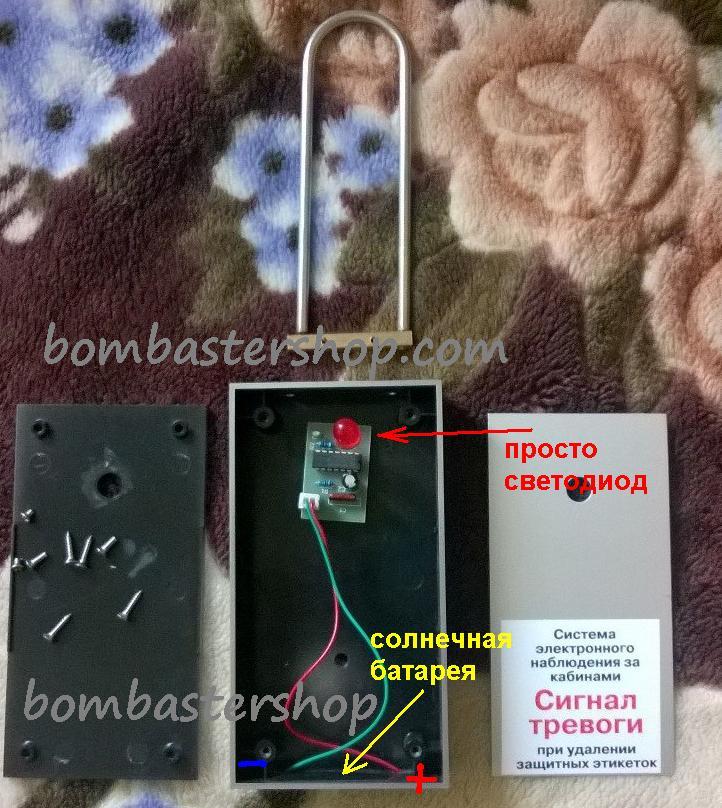
Oh... I almost forgot. There are indeed "Tag Removal Detectors" and you have likely seen them. For example, in NewYorker stores, where fitting rooms are "protected" by scary-looking boxes that:
- 1. Are connected to absolutely nothing.
- 2. Have a flashing LED (Oh no, it must be working!).
- 3. Feature aggressive stickers: SURVEILLANCE SYSTEM, ALARM, etc.
In reality, it's a box with an LED powered by a small solar cell located at the bottom of the unit.
As long as ambient light hits the photocell, energy is processed by a tiny circuit board... Yes, there is something inside... it accumulates a charge and blinks the LED.
Notice they are always installed where light can reach the cell. Cover the cell with your hand and witness the miracle:
The "sinister" red light stops flashing.
Visual Intel: